
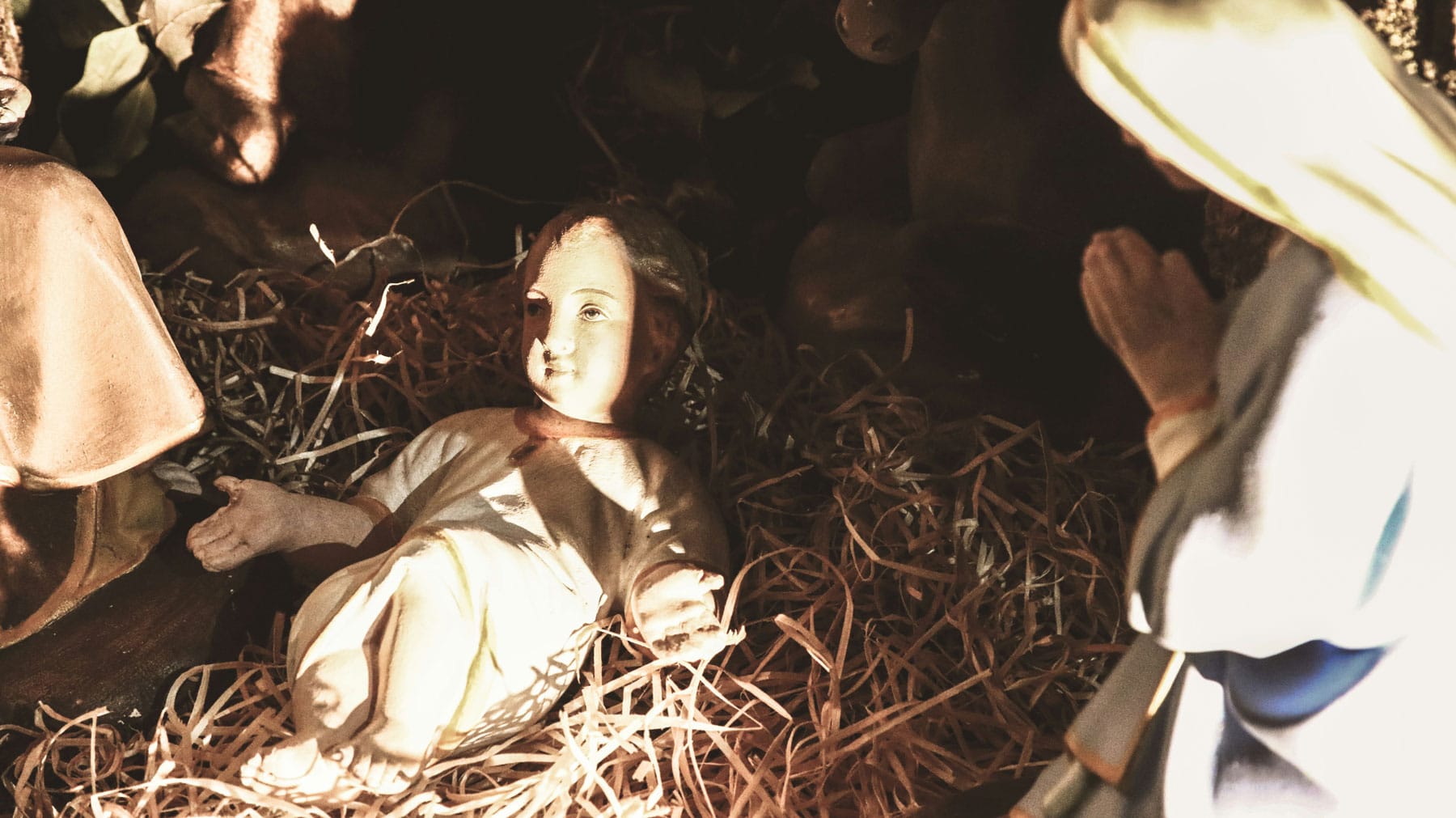
It’s the time of year when the Church calendar becomes loaded with Christmas parties, carol services and festive celebrations. There are so many wonderful opportunities to be together and celebrate the birth of the Lord Jesus.
However, amongst the busyness, it can be quite easy to overlook the incredible wonder of what it is that we are actually celebrating. In fact, it can often be the case that we end up thinking very little about just how much Christ has done for us in His incarnation. In this blog post, we want to delve a little more deeply into the theology of Christmas, so that we might be better equipped to teach these glorious truths in such a way that inspires awe and wonder in little hearts and minds.
So, as we think about what it meant for the Word to become flesh, here are 3 things for us to consider:
- Who – Who Was Involved?
- What – What it meant (for the Word to become flesh)
- Why – Why was it necessary for the Word to become flesh
So, to begin with let’s think about
1. Who was involved?
Who was involved in the Incarnation? You might think – well that’s easy – Jesus, the Son of God was involved. That is true of course – but the Bible presents a richer picture than that to us. In fact, Scripture teaches that ALL THREE persons of the Trinity played a role in the incarnation of the Son of God.
How was that the case? Let’s think first of all about the role of God the Father in the Incarnation. Hebrews 10:5, drawing here on Psalm 40:6, says:
Consequently, when Christ came into the world, he said, “Sacrifices and offerings you have not desired, but a body have you prepared for me;
So, the writer of Hebrews is talking about the humanity of Christ and includes this important detail that the body that the Lord Jesus assumed was prepared for Him by His Father. It’s quite a thought that isn’t it? That God the Father prepared a body for His Son – in order that His Son might accomplish the work of salvation. Why did Jesus need a body? Well, He needed a body in order that He might offer up His body as the Once and for all sacrifice for sin. He needed a body in order that His body might be broken and his blood shed for your sin and mine. And He needed a body in order that He might rise from the dead. Christianity teaches the bodily resurrection of the Lord Jesus – that truth lies right at the heart of the Christian gospel. In fact, more than that, Christianity teaches that Christ’s resurrected body is a foretaste of or a prototype of our resurrected bodies. What we see to be true of Him in His resurrected existence will, in a sense, one day also be true of all who trust in Him in our resurrected existence.
God the Father prepared a human body and soul and mind for His Son in order the He might do the work of rescuing a people for Himself.
Sam Allberry helpfully points out that,
‘the incarnation of Jesus Christ is the highest compliment the human body has ever been paid.’
The Holy Spirit was also involved in the Incarnation. We confess this together anytime we say the Apostles Creed, don’t we? I believe in Jesus Christ, his Son, our Lord…who was conceived by the Holy Spirit, born of the Virgin Mary. We also read about this in the Bible, most often Christmas time. Luke 1:35:
‘The Holy Spirit will come upon you, and the power of the Most High will overshadow you; therefore the child to be born will be called holy – the Son of God.’
Or Matthew 1:18
‘Now the birth of Jesus Christ took place in this way. When his mother Mary had been betrothed to Joseph, before they came together she was found to be with child from the Holy Spirit.’
The Spirit of God was involved in the Incarnation. Mary was too of course – she is incredibly significant in all of this (but that is another blog for another time!)
For now, it is important that we recognise the role of the Holy Spirit. Think of an architect and a builder. If God the Father was the master architect designing and preparing a body for His Son, the Spirit was a master builder, forming the body and human nature of Christ in Mary’s womb.
The Father was involved. The Spirit was involved. Then obviously of course the Son was involved. He IS the very Word made flesh. And specifically, we need to see that the decision to assume a human nature belonged to God the Son. He didn’t have to be coerced or strong-armed into becoming man – that is not how the Triune God of the Bible works. No – all that Jesus did for His people He did so willingly and voluntarily. That’s why those famous verses in Philippians 2:5 are so helpful for us:
Have this mind among yourselves, which is yours in Christ Jesus, 6 who, though he was in the form of God, did not count equality with God a thing to be grasped, 7 but emptied himself, by taking the form of a servant, being born in the likeness of men. 8 And being found in human form, he humbled himself by becoming obedient to the point of death, even death on a cross.
He humbled HIMSELF. He did so gladly and willingly and voluntarily…and he did so out of love for both His Father and for those that His Father had given Him.
So, when we think about the Incarnation and who was involved – the answer is the Triune God – Father, Son and Holy Spirit were all intricately involved in the Word becoming Flesh. That is important for us to have in place before we go on to think about anything else.
2. What did it mean (for the Word to become flesh)
This is where things can get a little bit more complicated – but please do stay with me – this is really important for us to think about carefully.
Classically Christians have spoken about Jesus being both fully God and fully man. That is good, historic, orthodox language when it comes to explaining what happens at the Incarnation.
Jesus is not part God and part man – 50% of each.
Nor is He God for all eternity…and then turns into a man for the time He lived on earth… goes back to Heaven and becomes God again.
He is fully God and fully man. And to help flesh that out a bit more Christians have used the language of Jesus being ONE person (the Son of God) but with TWO natures (a divine nature and a human nature).
To help us at least try to understand this let’s use some language from the world of mathematics. When we think about what it meant for the Word to become flesh we need to think in terms of addition and not subtraction.
So, in addition to his divine nature, Jesus when he came to earth in his Incarnation, took on a second nature, a human nature. So, think back again to those verses in Philippians 2:
Have this mind among yourselves, which is yours in Christ Jesus, 6 who, though he was in the form of God, did not count equality with God a thing to be grasped, 7 but emptied himself, by taking the form of a servant, being born in the likeness of men.
He emptied himself by TAKING the form of a servant…by being born in the likeness of men. In other words, Jesus adds to Himself a human nature. He doesn’t lose any of His divine nature, He does not cease to be the eternal Son of God…rather He ADDS to himself a human nature.
This is what it means to speak of Christ Incarnate. Even that word incarnate gives us an insight into the wonder of all of this. Carne is the Latin word for meat or flesh. God the Son takes on the meat of human flesh. He takes on a human body and a human soul and a human mind – with all the limitations and restrictions that brings. He really is fully human. He remains fully divine – but the Son of God added to himself a human nature.
So, everything that it means to be human is true, now, for Jesus. Except of course – he was without sin (see Hebrews 4:15).
Jesus didn’t just slip on a skin suit. He didn’t just appear as a man. Nor was his taking on of a human nature a temporary thing – even now in his resurrected existence he is both fully God and fully man. That means that right at this very moment there is a single fully human body in heaven and He is seated at the right hand of God the Father. Quite an incredible thought.
So, this language and idea of addition is really important. The Son of God taking on a human nature was addition and not subtraction. Jesus didn’t give up any of his divine power when he became man…and yet in his human nature he fully experienced the limitations of what it meant to be one of us.
John Calvin put it like this:
‘The Son of God descended from heaven in such a way that, without leaving heaven, he willed to be borne in the virgin’s womb, to go about the earth, and to hang upon the cross yet he continuously filled the world even as he had done from the beginning.’
Hard to understand? Yes! Impossible even. Let me try and simplify things a little bit with an illustration. Imagine the great author J.R.R. Tolkien wrote himself into his great Lord of the Rings saga. Imagine he was there with Frodo journeyed to Mordor and sought to destroy the ring. Would he then have ceased to exist in his home in Oxford? Would he be any less powerful there? Any less real? Any less conscious? Would his appearance or existence in Oxford be in anyway changed by his appearance in his creation – the Lord of the Rings saga?
The answer to all those questions is No.1This is not a perfect illustration of course – there are some potential problems with it if we aren’t theologically careful. However, it does give us at least a tiny glimpse into how Jesus could remain fully divine while also taking on flesh in the realm of His creation.
That is at least a little bit what it is like with Christ. He remains the King of Glory – the One who perfectly rules over the entire universe and upholds the whole world by the word of His power.
And yet He takes onto Himself a human nature. In the same way that a King might conceal his true glory by throwing on a beggar’s cloak and clothes, so too Jesus conceals his by adding to his divine nature a human nature.
So, when you think of the incarnation – think addition and not subtraction.
Here is a helpful little phrase from church history to remember – because even if we don’t fully comprehend these things that doesn’t mean that we shouldn’t rejoice and worship over them.
Gregory of Nazianzus was the Archbishop of Constantinople (modern day Istanbul) in the fourth century. He described the incarnation like this:
‘Remaining what He was, he became what He was not.’
Jesus remains what He was – fully God. And yet He also became what He was not – fully man.
So, keeping everything that it means to be God – His omnipotence, His omnipresence, His omniscience, His perfect and absolute sovereign rule over all things…keeping all those things…he became everything it means to be a man.
So incredibly that means that according to his human nature Jesus had to learn how to walk, how to use a knife and fork, how to hold all the tools that he would have needed to become a carpenter like Joseph. He had to be potty trained, he had to learn how to talk, how to He had to learn how to read and write. He had to learn how to read the Bible and he even had to learn that what was contained in the Scriptures was ultimately about HIM. What an incredible thought!
Is there great mystery in all of this? Yes – absolutely. It is incredibly complex – we are delving deep into the mysteries of God here. It is why the hymn writer Charles Wesley once wrote ‘our God contracted to a span, incomprehensibly made man.’
These things are complex for us and yet they are crucial for us to contemplate and to be clear on in order for us to know Jesus Christ and make Him known.
3. Why – why was it necessary for the Word to become flesh?
In a sense this is an easier question for us to answer – it was necessary for the Son of God to become man because of our sin…or more specifically to rescue and redeem us from our sin.
As human beings we are corrupted by sin in every aspect of our being. Our minds are darkened, our wills are enslaved and our bodies are cursed by decay and death. So, we need to a saviour to rescue every aspect of our being.
If he was not fully human, then He could not represent nor redeem humanity fully. To redeem our bodies, minds and souls Jesus had to have a truly human body, mind and even soul. He had to be one of us in order to live the life that we should have lived and then die the death that we should have died. It is His perfect human life that qualifies him to be our substitute.
Sometimes we might be tempted to think that being sinless was the only qualification our Saviour needed. But that isn’t the case. It wasn’t just a sinless substitute that was required – otherwise an angel could have died for our sins. But the angel Gabriel for example, was not a human. Even if he had wanted to, Gabriel would no more have been able to pay for our sins than all the goats and bulls of the Old Testament! No – our Saviour needed to be a sinless, spotless HUMAN substitute. Otherwise, Hue simply could not stand in our place.
Equally, we must also say that if Jesus was not fully GOD, then He could not earn salvation for us. So again think of the example of the angel Gabriel – he could not live and die for us in order to save us because it was not Gabriel whom we sinned against.
If I stole £100 from a work colleague, then only that colleague has the right to forgive me. My wife turning up and saying she forgives me doesn’t work – it isn’t just. If Jesus was not fully God, then he would be a third party trying to rescue us from God, rather than the God we sinned against lovingly substituting himself for us.
No – our Redeemer had to be both fully God and fully man in order to do for us what we could never do for ourselves.
Jonty Rhodes helps us to see why these things are intrinsic to our grasp of the gospel:
‘Why does this matter? Is it just theological hairsplitting for those who like their brains scrambled? NO – this is the heart of the gospel. Jesus is the Saviour, and his salvation rests on him being the God-man. If Jesus is not fully divine and fully human, then there IS no salvation.’
These things are crucial for us to believe. May you know the joy of the Lord this Christmas as you reflect upon the wonder of the incarnation – and may you know His help as you seek to teach these truths to children, young people and families.
- 1This is not a perfect illustration of course – there are some potential problems with it if we aren’t theologically careful. However, it does give us at least a tiny glimpse into how Jesus could remain fully divine while also taking on flesh in the realm of His creation.


